
Abstract
McKennaii is a name for one cultivated line of Psilocybe cubensis. The species is defined in the botanical literature; the name McKennaii is not. It was given by growers or sellers, it is not registered anywhere we could find, and a culture sold under that name by one supplier is not guaranteed to be the same culture sold under that name by another. Genome data show that commercial cubensis cultivars in general are closely related and genetically uniform.
Keywords taxonomy, cultivar, Psilocybe cubensis, genome
The species behind the name
Psilocybe cubensis was first described in 1906 by the American mycologist Franklin Sumner Earle as Stropharia cubensis, from material collected in Cuba. In 1949 Rolf Singer moved it to the genus Psilocybe, which gives the full name Psilocybe cubensis (Earle) Singer (Wikipedia: Psilocybe cubensis1). In the wild it grows on cattle dung and manured pasture in tropical and subtropical regions, including the south-eastern United States, Mexico, Central and South America, South-East Asia and Australia.
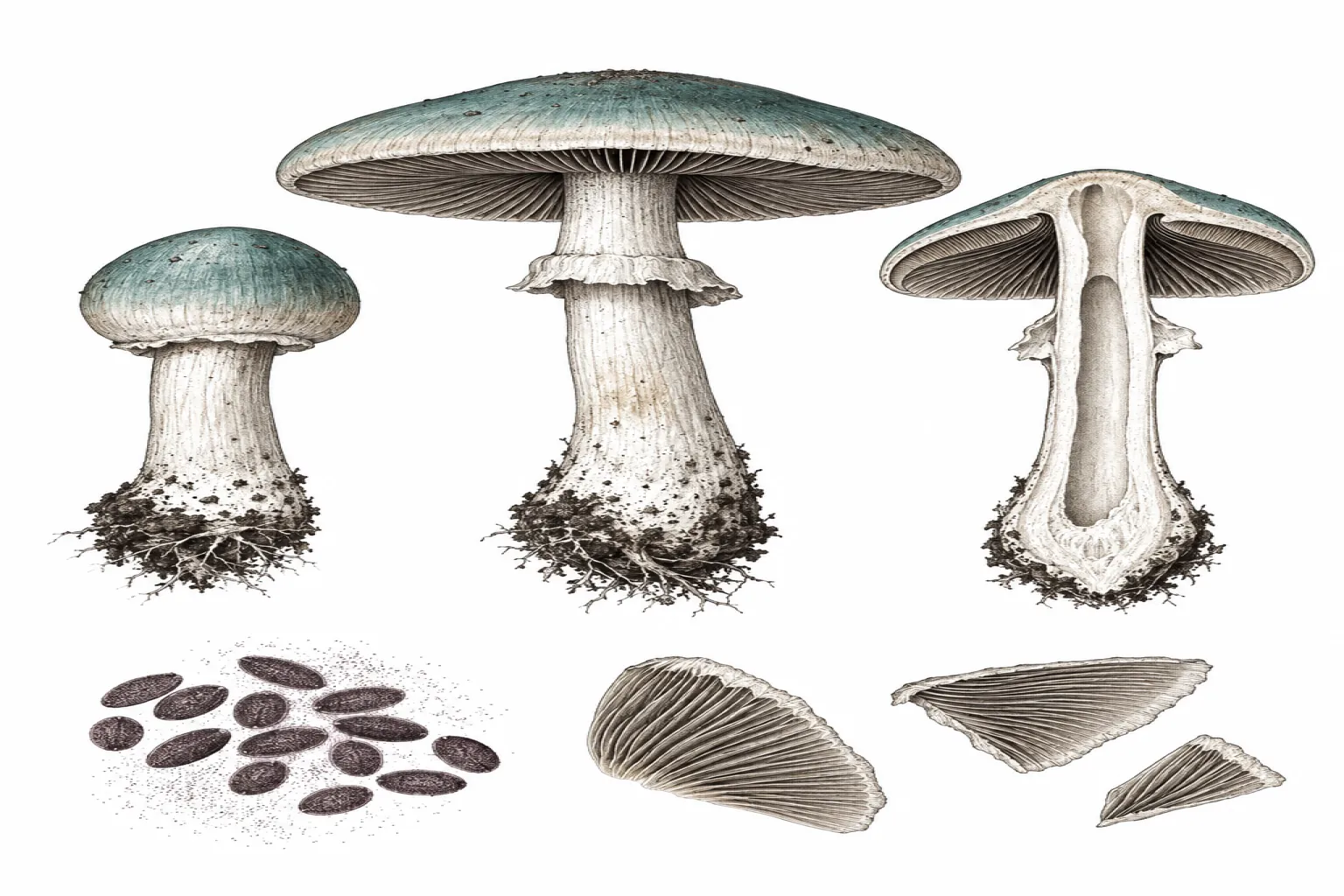
The standard description, as summarised in a 2025 review in the Journal of Fungi, gives a cap of 16 to 80 mm that opens from conical or bell-shaped to flat and changes from whitish to ochre-brown, gills that turn from pale grey to dark sepia, and a hollow stem of 20 to 80 mm (Kurzbaum et al., 20252). The spore print is purple-black. Any McKennaii fruit body falls inside that description; there is no published feature that separates it from other cultivars.
Species, variety, cultivar: three different kinds of name
Table 1. Where McKennaii sits among the names used for these mushrooms.
| Level | Example | Who defines it | Registered |
|---|---|---|---|
| Genus | Psilocybe | mycologists, under the botanical code | yes, in nomenclature databases |
| Species | P. cubensis (Earle) Singer | formal description with a type specimen | yes |
| Variety | P. cubensis var. caerulascens | formal description (Singer) | yes |
| Cultivar or strain | McKennaii, Golden Teacher, B+ | growers and vendors | no register found |
Species and varieties are published with a description and a reference specimen, so anyone can check what the name covers. Strain names in the cubensis trade work differently. The 2025 review cited above notes that its own descriptions of named strains are "predominantly sourced from non-academic, community-based reports", because legal restrictions have limited formal research. A name such as McKennaii therefore tells you about a seller's catalogue, and only indirectly about the organism.
This also explains a common error. Because the name ends in "-ii", it is sometimes written as if it were a species, Psilocybe mckennaii. A 2016 laboratory methods paper from the Vrije Universiteit Amsterdam called its test material "Psilocybe Mckennaii" (Otvos et al., 20163), and a 2025 review table lists "P. McKennaii" among real Psilocybe species (Luz et al., 20254). No species of that name has been described.
What the genome data show
A sample labelled McKennaii, grown from spores and collected in the United States in April 2021, was whole-genome sequenced the same year as part of a larger sequencing project on psilocybin mushrooms. The record and its raw reads are public (NCBI BioSample SAMN200143335). The record lists the organism as P. cubensis and makes no comparison with other cultivars.
The broadest analysis of cultivar genomes so far compared 86 commercially available cultivars with 38 wild isolates from Australia (McTaggart et al., 20236). The cultivars showed the marks of inbreeding and clonal propagation: low genetic diversity, low heterozygosity and few variants of the mating-type genes. Kinship analysis showed that most cultivars were founded from related populations, and the alleles in the psilocybin gene cluster were identical across most of them. The Australian wild population was more diverse.
The abstract of that study does not name individual cultivars. One of its co-authors, the mycologist Caine Barlow, told DoubleBlind magazine that sequencing supports the account that McKennaii was developed in the Netherlands, and that it is essentially Golden Teacher under another name (DoubleBlind7). We could not check that statement against published data, so read it as an expert's comment, not a finding.
What this means for the label on a kit
- The species on the label, P. cubensis, is reliable and checkable.
- The cultivar name says which culture the supplier keeps under that name. Two suppliers can keep different cultures under the same name.
- Differences you read about between McKennaii and other cultivars (size, colour, speed, strength) come from growers and shops. Lab data on strain differences, discussed in the next paper, did not include McKennaii.
Next: where the name comes from, or growing McKennaii from a kit.
References
- Wikipedia: Psilocybe cubensis en.wikipedia.org/wiki/Psilocybe_cubensis
- Kurzbaum et al., 2025 pubmed.ncbi.nlm.nih.gov/39997393
- Otvos et al., 2016 pubmed.ncbi.nlm.nih.gov/26738519
- Luz et al., 2025 pubmed.ncbi.nlm.nih.gov/40732278
- NCBI BioSample SAMN20014333 ncbi.nlm.nih.gov/biosample/SAMN20014333
- McTaggart et al., 2023 pubmed.ncbi.nlm.nih.gov/38052161
- DoubleBlind doubleblindmag.com/mckennaii-mushrooms