
Abstract
A McKennaii grow kit is a block of substrate that is already fully colonised by Psilocybe cubensis mycelium; you supply warmth, humidity, fresh air and indirect light, and mushrooms form within weeks. Nothing published shows that McKennaii needs different conditions from other cubensis cultivars, and the shop's instructions are the same as for its other kits. Before anything else: in the Netherlands buying the kit is legal, but the mushrooms are illegal as soon as they appear. Read legal status first.
Keywords grow kit, flushes, Trichoderma, bacterial blotch
What arrives in the box
Dutch-Smart sells McKennaii in two ready-to-grow formats. The FreshMushrooms kit contains a 1200 cc grow box with colonised substrate, a grow bag with air filters and a manual in Dutch and English. The XXL kit holds a 2100 cc block. According to the shop, kits are a fresh product: set them up on the day they arrive, or keep them in the refrigerator for at most one day.
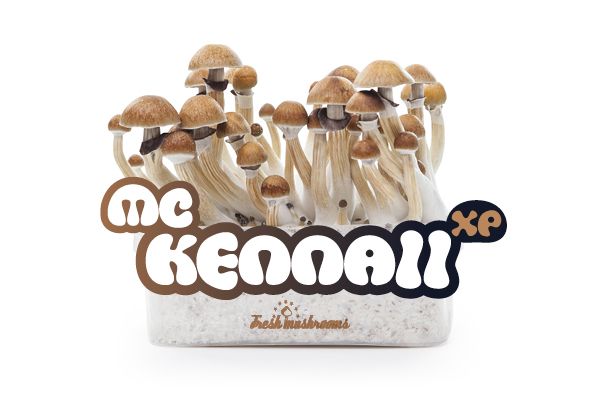 Cat. DS-2778
McKennaii - FreshMushrooms Magic Mushroom Grow Kit
Cat. DS-2778
McKennaii - FreshMushrooms Magic Mushroom Grow Kit
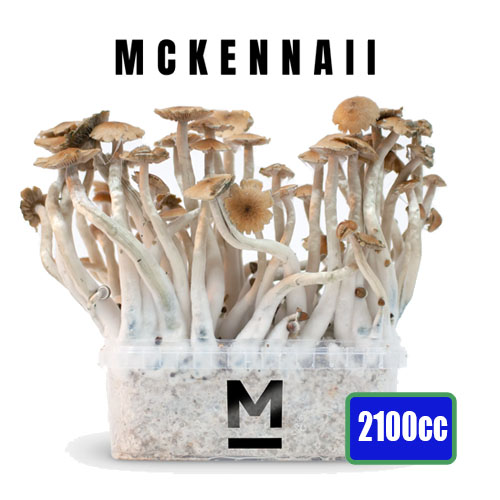 Cat. DS-2765
McKennaii XXL - 2100cc Mushroom Grow Kit
Cat. DS-2765
McKennaii XXL - 2100cc Mushroom Grow Kit
What the shop's instructions say
Table 1. Growing conditions as given by Dutch-Smart. These are the producer's recommendations, not measurements.
| Factor | Shop guidance |
|---|---|
| Temperature | 21 to 25 °C in the Dutch manual, 23 to 26 °C in the English FAQ |
| Below 20 °C | slower growth |
| Above 28 °C | more risk of contamination |
| Humidity in the bag | 80 to 95% |
| Light | indirect daylight, as a signal to start fruiting |
| Fresh air | open the bag daily |
| First harvest | 1 to 3 weeks after set-up |
| Number of harvests | 2 to 4 flushes, the first usually the largest |
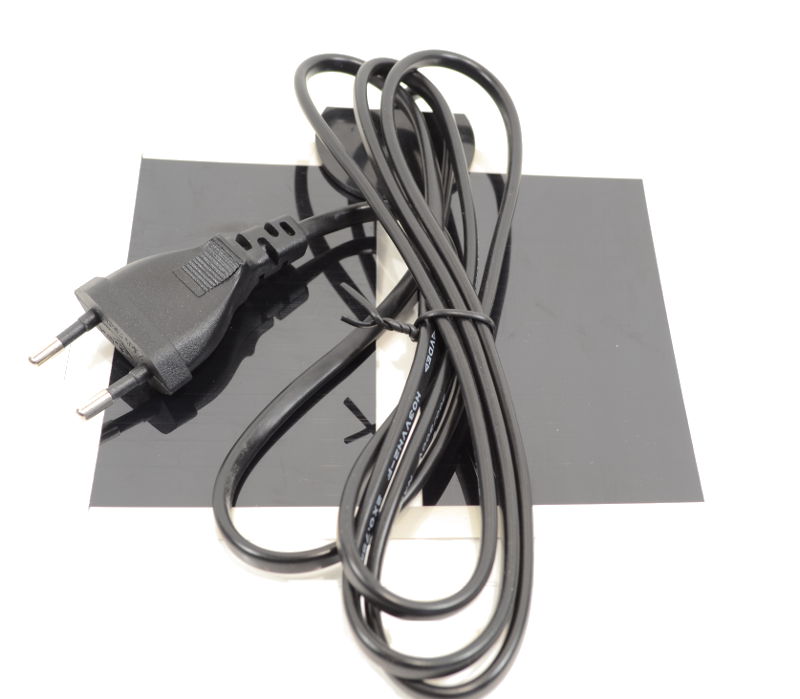
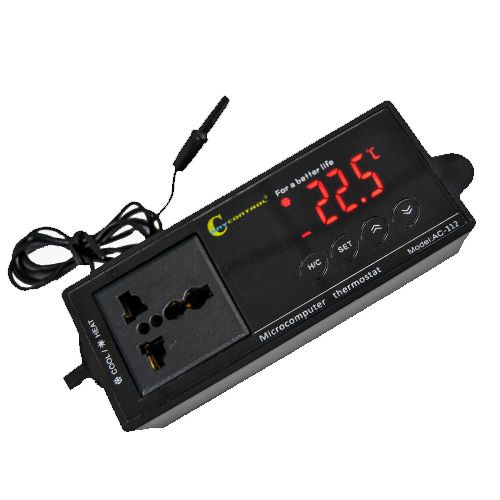
The two temperature ranges come from the shop's Dutch manual (Dutch-Smart manuals) and its English FAQ (Dutch-Smart FAQ); they overlap between 23 and 25 °C. In a cool room, a heat mat with a thermostat keeps the kit in range.
What is specific to McKennaii
Very little that can be checked. DoubleBlind magazine describes McKennaii as beginner-friendly, with medium to large fruit bodies and a first flush within about a month, but no one has compared it with other cultivars under controlled conditions. The genome data summarised in what McKennaii is show that commercial cultivars are closely related, which fits with the absence of special requirements. If a kit does not behave as the manual says, the cause is almost always temperature, humidity or contamination, and those are the same for every cultivar.
Recognising contamination
A kit is a warm, wet block of nutrients, and other fungi and bacteria grow on it as readily as cubensis does. Most problems can be recognised by colour and texture.
Table 2. Common findings in cubensis grow kits and what they mean.
| What you see | Likely cause | What to do |
|---|---|---|
| blue or blue-green stains on mushrooms or mycelium where touched | oxidation of psilocin, harmless | nothing |
| white, dense mycelium that turns green and powdery | green mould, Trichoderma | close the bag, dispose of the kit, clean the area |
| loose, cotton-like fluff over the surface and over mushrooms | cobweb mould, Cladobotryum | usually dispose of the kit |
| yellow to brown, slimy spots on caps that stayed wet | bacterial blotch | keep caps dry; remove affected mushrooms |
| orange-white wisps becoming a bright orange powder | Neurospora | close the bag, dispose of the kit outdoors |
| sour or rotten smell | bacteria | dispose of the kit |
The blue colour has been explained chemically: two enzymes in P. cubensis first convert psilocybin to psilocin and then oxidise it, after which psilocin units link into blue chains (Lenz et al., 20201). The colour marks damaged tissue and is no sign of decay.
Green mould is a known problem in commercial mushroom farming too; Penn State Extension describes a dense white growth followed by green sporulation (Penn State Extension2). Dutch-Smart's own FAQ says an infected kit can almost never be recovered. Cobweb mould is described by Penn State as cotton-like, usually white, sometimes grey, pink or yellow (Penn State Extension, fungal diseases3). Bacterial blotch appears where caps stay wet for four to six hours or longer (Penn State Extension, bacterial blotch4). Neurospora can turn into a bright orange, powdery patch within about a week (Niloy et al., 20245).
Preventing it
- Wash your hands or wear gloves before opening the bag, and wipe surfaces first.
- Keep the kit below 28 °C; the shop links higher temperatures to more contamination.
- Do not spray water directly on caps, and drain any standing water.
- Close and remove a contaminated kit at once, before its spores spread.
What the harvest contains, and how much that varies, is covered in strain differences.
References
- Lenz et al., 2020 pubmed.ncbi.nlm.nih.gov/31725937
- Penn State Extension extension.psu.edu/green-mold-of-mushrooms
- Penn State Extension, fungal diseases extension.psu.edu/basic-ipm-practices-for-organic-mushroom-far…
- Penn State Extension, bacterial blotch extension.psu.edu/bacterial-blotch-disease
- Niloy et al., 2024 frontiersin.org/journals/industrial-microbiology/articles/10.3…